Social
copy trading without copying someone's losses
Anyone can look like a genius for a week. Here is how to check a trader's record properly before you put money behind their next entry.
10 min read
Copy trading is the reason to use FOMO instead of a plain swap app. It is also the fastest way to lose money on FOMO, because copying someone is a decision that feels like research while involving none. This guide is about the gap between those two things.
What copying actually means here
FOMO's social layer does three separate things and it is worth keeping them apart in your head:
- The leaderboard ranks traders by results, so you can find people worth paying attention to.
- Following puts a trader's activity into your feed.
- Alerts notify you in real time when a trader you follow buys.
The Alerts panel is the sharpest of the three, because each line tells you the trader, whether it was a buy or a sell, the size, and crucially the market cap they did it at. There is a minimum-size filter on it too, so you can drop everything below a threshold and stop being notified about hundred-dollar nibbles.
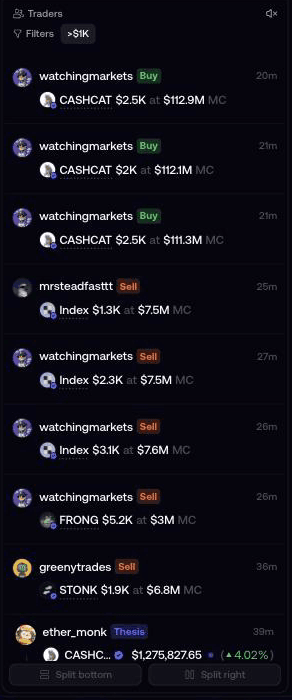
None of those three place a trade for you. When an alert arrives, you are still the one deciding to enter, at your size, with your exit, holding your risk. That distinction matters enormously, because it means the trader you are copying has no obligation to you and no idea you exist.
They are already in profit when you get the alert
A trader you follow bought at some market cap. By the time the alert reaches you and you act on it, the price has moved, sometimes a lot, precisely because other followers acted too. You are systematically entering worse than the person you are copying, and they are systematically able to exit into your buying. Every copy trade starts from behind.
How to evaluate a trader before you follow them
A trader at the top of a leaderboard has, by definition, been winning recently. That is the whole selection criterion, and it is not the same as being good. Anyone who takes enough high-variance positions will eventually have a spectacular month. Here is what to check before you decide which one you are looking at.
Is the record one trade or many?
Open their profile and look at the distribution of results, not the headline number. One 200x on a tiny position that happened to hit, surrounded by mediocrity, is luck wearing a costume. Consistent moderate wins across many positions is a process. Prefer the second, even when the first has a bigger number attached.
The leaderboard's timeframe switch is the fastest version of this check. Compare who is top over 24H against who is top over 30D and ALL. A name that only exists in the 24H column had a day. A name that holds up across all four had a method.
What do their losses look like?
This is the most informative thing on any trader's profile and the part nobody reads. Everyone has losers. What you want to know is whether their losers are small and frequent, which means they cut positions, or rare and catastrophic, which means they hold losers hoping and have simply not been punished for it yet. The second profile produces beautiful leaderboards right up until the trade that ends it.
How long do they hold?
A trader whose average hold is four minutes is running a strategy you cannot copy from a phone notification. You will get in after they got in and out after they got out, which is a formula for paying both spreads. Look for hold times you could realistically match given your actual life.
You do not have to guess at this. The holders table on any token page prints average hold time directly under each trader's name, beside the market cap they entered at and their running PnL. Two minutes there tells you more than any leaderboard rank.
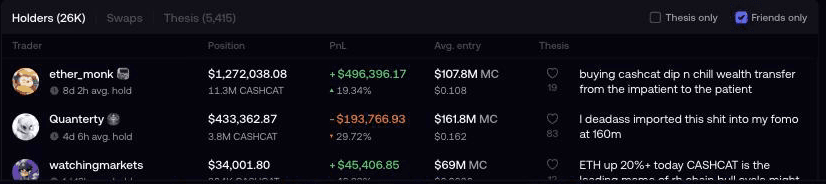
How big are their positions relative to their account?
Someone risking a small fraction per trade is running something durable. Someone going all-in every time will eventually meet the trade that goes to zero, and if you are copying at the same conviction, so will you.
Are they trading, or performing?
Look at what they post alongside what they do. A trader whose posts consistently appear after the entry, explaining a position they already hold, may be building an audience to sell into. That is not automatically bad faith, but it changes what their calls are for.
The cheapest audit there is
Follow a trader and take none of their trades for two weeks. Track what would have happened if you had, at your realistic entry, not theirs. It costs you nothing and it answers the only question that matters far better than any leaderboard rank.
Using alerts without letting them use you
Real-time alerts are the sharpest tool in the app and the easiest one to hurt yourself with. The failure mode is obvious once described: notifications arrive, each one feels urgent, urgency crowds out the checks, and within a week you are taking every alert at any size at any price. That is not copy trading, that is being farmed.
Three rules that keep alerts useful:
- Alerts only from traders you have audited. If you cannot describe how someone loses money, you should not have their notifications switched on.
- An alert is an input, not a trigger. When one arrives, open the token page and do the same reading you would do for anything else: liquidity, holders, who else is buying. If the answer is bad, the alert does not override it.
- Your size and your exit, always. You do not know their account size, their conviction, or their plan. Copying an entry while inventing your own risk is the only version of this that works.
The exit problem nobody mentions
Entries are broadcast. Exits often are not, or at least not fast enough to help you. You can end up in a position you took because someone you follow bought, with no idea whether they are still holding it. If your entire thesis was they bought, then the moment they leave, your thesis is gone and you may be the last to know.
The fix is to never hold a position whose only justification is someone else. Use their entry as a lead, then form your own reason to be in it, and set your own exit against that reason. If you cannot come up with one, the honest conclusion is that you do not want the trade, you want the reassurance.
The other direction
Everything above works in reverse. Your trades are visible too, and a public record of small losses cut quickly and profits taken sensibly is worth far more over time than one enormous win. If you want to be on the side of the leaderboard people follow, that is covered in the leaderboard and feed guide.
And before you copy anyone at any size, read why most memecoin traders lose. Copying a good trader with bad position sizing still ends in the same place.