Trading
your first trade, end to end
Read a token page without flinching, work out what the market cap is telling you, place a buy, and decide in advance where you are getting out.
9 min read
Your first trade on FOMO takes about ninety seconds. Doing it well takes about ten minutes, and most of that is reading the token page properly instead of tapping buy because a chart was green. This guide walks the whole thing, in order, and tells you what each number on the screen is actually claiming.
Before you start
Have an account funded with an amount you would shrug at losing. If you have not done that yet, the getting started walkthrough covers download, account and funding first.
Reading a token page without flinching
Every token in FOMO gets its own page, and it is dense on purpose. The chart takes up the middle, the buy and sell panel sits on the right, and the numbers strung along the top are the ones that decide whether the chart matters at all. Work through them in this order.

Market cap
Circulating supply multiplied by price. For a memecoin, stop treating this as a valuation and start treating it as a measure of attention: how much money has already decided this token is interesting. A token at $80k market cap has almost no one in it, which means enormous upside and equally enormous odds it is a scam or simply dies. A token at $80m has had its move already, and for it to double, another $80m has to arrive.
The practical question is never is this cheap. It is who still has to buy this for me to be right.
Liquidity
The money sitting in the pool you are trading against. This is the number newcomers skip and then learn about the expensive way. If a token has $40k of liquidity and you try to sell a $4k position, you are not getting anywhere near the quoted price, because your own order moves the market against you on the way out.
A rough sanity rule: your position should be small enough relative to liquidity that exiting it is boring. If the size you want to trade is a visible fraction of the pool, trade smaller or trade something else.
Holders
How many wallets hold the token. What matters more than the raw count is the shape of the distribution, which the holders table on the token page shows you. A handful of wallets holding most of the supply means a handful of people can end the chart whenever they feel like it.
Volume and recent trades
Volume tells you how much has actually changed hands. The trades list next to it tells you who. This is the part of FOMO that other apps do not have: you can see named traders buying and selling in real time, along with the market cap they did it at. A wall of buys from accounts with real track records is a different signal from a wall of buys from wallets created eleven minutes ago.
The holders table underneath the chart is the best of it. Every row gives you a trader, their position size, their unrealised PnL, the market cap they entered at, how long they have held, and the thesis they posted. That is a complete picture of who is in front of you and at what price, which most trading apps will never show you.
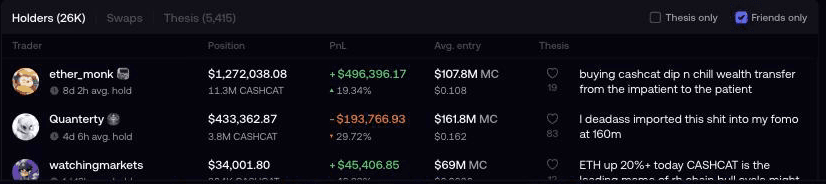
Next to Holders you get Swaps, the raw buy and sell flow, and Thesis, where traders write down why they are in. Reading a few theses is the fastest way to find out whether there is an actual reason behind a move or whether everyone is simply pointing at the chart.
The chart is the least informative thing on the page
A memecoin chart shows you what already happened to people who are not you. The liquidity, the holder concentration and who is currently buying are forward looking. Read those first and the chart last.
Placing the buy
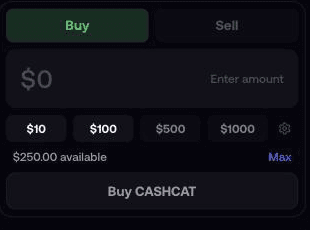
The buy panel lives on the right of the token page, with preset amounts and a free entry field. Three things to do before you tap it.
Decide the size first, in money, not in feelings. Write the number down before you open the panel. The panel is designed to be fast, and fast is the enemy of a considered position size. If you have not read the risk management guide, the short version is: one position should never be able to meaningfully hurt your account.
Read the fee line. FOMO shows the fee for the trade in the panel before you confirm, alongside the amount you are spending. Read it there, on the screen, every time. Fees change, and a number you memorised from a website six months ago is not a fee schedule.
Check the estimated amount you receive. If the tokens you are quoted look meaningfully worse than the price implies, that gap is slippage, and it is telling you the pool is too thin for the size you are trying to trade. Reduce your size until the quote looks sane, or walk away.
Deciding the exit before you need it
Here is the single behaviour that separates traders who last from traders who donate: the exit is decided while you are calm, which is now, and not while the position is moving, which is when you are incapable of deciding anything.
Before you confirm the buy, write down two numbers:
- Your take-profit. The market cap or multiple at which you sell at least your original stake back out. Not the price at which you will feel rich.
- Your invalidation. The level at which the reason you bought is no longer true, and you exit whether or not it feels premature. Volume dying, liquidity being pulled, the deployer selling, or simply a price you decided in advance.
Both of those are decisions, not orders. Treat them like appointments you have already agreed to keep.
Taking profit in pieces
The most reliable way to stay solvent in memecoins is boring and unpopular: when a position is meaningfully up, sell your original stake back out. You now hold a position that cost you nothing, your downside is capped at zero, and you can let the rest run without the outcome mattering to your account. Traders call what is left a moonbag.
This will feel wrong roughly half the time, because half the time it keeps going and you sold some. That is the price of never being wiped out by the other half. The alternative, holding everything for the number you imagined, is how people turn a 5x into a round trip back to their entry, which happens constantly and is much less interesting than it sounds.
A workable default for a first trade
Sell your original stake at 2x. Let the remainder ride with no target and no anxiety, because it is now house money. Revisit the position only if the reason you bought stops being true.
After the trade
Whatever happened, write down why you entered and how it went. Not a spreadsheet, a sentence. After twenty trades you will have something almost nobody trading memecoins has, which is evidence about your own behaviour rather than a vague sense that you are unlucky.
The patterns that show up are always the same: entries taken because something was already moving, sizes that crept up after a win, exits abandoned mid-position. All three are fixable, but only once you can see them.
Next, learn the part of FOMO that actually gives you an edge over trading on any other app: following traders worth following.