Social
the leaderboard and the feed
The social layer is the actual product. Learn to read it for signal, and to post in a way that builds a record worth following.
8 min read
Most trading apps give you a chart and leave you alone with it. FOMO's actual product is the layer on top: a leaderboard of who is winning and a feed of what people are doing right now. Used carelessly it is a machine for chasing. Used well it is genuinely faster than sitting alone refreshing charts.
What the leaderboard is telling you
The leaderboard ranks traders by performance. That is a useful list and a misleading one at the same time, and the reason is selection: a ranking by recent results will always be topped by whoever combined a good process with a good run, or simply had a good run. From the outside those look identical.
So treat the leaderboard as a source of candidates, never as a ranking of skill.
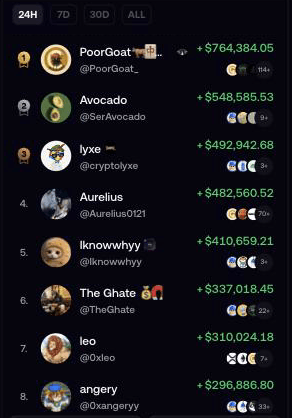
Use the timeframe tabs, they are the whole trick
The leaderboard runs on 24H, 7D, 30D and ALL. Reading only the default 24H view is how you end up following someone's single good day. Flip between all four and watch which names survive the change. Somebody who is top ten on 24H and nowhere on 30D got lucky recently. Somebody present on 30D and ALL is running something that repeats, which is the only property worth copying.
Look for repeat appearances
The same idea over calendar time. Check the board across several days rather than reading it once. Names that keep showing up across different market conditions are doing something repeatable. Names that appear once with a spectacular number and vanish had a moment. The first group is worth following, the second is worth learning from and not copying.
Clans
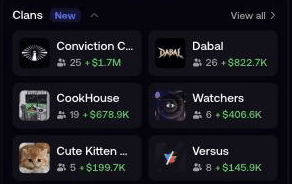
Above the individual rankings sit Clans, which are groups of traders ranked collectively by member count and combined profit. They are useful as a discovery surface: opening a strong clan gives you a pre-filtered list of traders to audit rather than a cold leaderboard. The same caution applies, since a clan's number is the sum of its members and can be carried by one or two of them.
Open the profile, not just the rank
Every ranked trader has a profile with their history on it. The rank is a headline, the history is the article. What you want is the shape of their losses and their typical hold time, both of which are covered in detail in the copy trading guide, because that is the audit that decides whether a name on a list is useful to you.
Rank is a result, not a reason
Nobody is at the top of the leaderboard because they are careful. They are there because they made money recently, which sometimes comes from being careful and sometimes comes from taking risks that have not yet been punished. The list cannot tell you which, and that is what the profile is for.
Reading the feed for signal
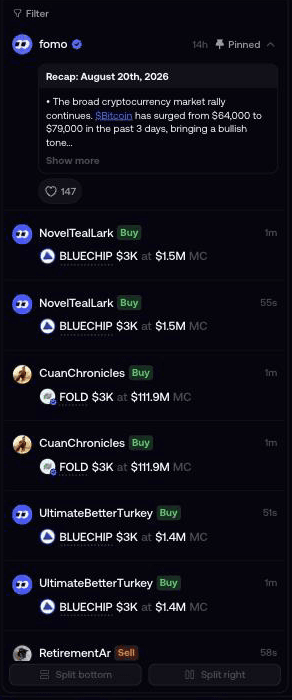
The feed shows you trader activity as it happens. The mistake almost everyone makes early is reading it as a series of instructions. It is better read as a stream of evidence about attention, and there are a few specific shapes worth noticing.
Independent clustering
One credible trader buying a token is a data point. Four credible traders who do not obviously coordinate buying the same token within a short window is a much stronger one, because it suggests something real surfaced rather than one person's call propagating. The word doing the work there is independent: four accounts who always trade together are one data point wearing four hats.
Who is selling
The feed shows exits as well as entries, and exits are the underused half. A token with loud buying in your notifications and quiet, steady selling from the accounts that got in early is telling you exactly what stage of the move you are being invited into.
Sequence and timing
Notice whether a trader posts before or after entering. Someone who publishes a thesis and then builds a position is doing something different from someone who builds a position and then publishes a thesis. Neither is disqualifying. Only one of them lets you in at the same time as them.
The feed is fastest at the wrong moment
Social velocity peaks slightly after price does, because the thing that makes people post is the move having already happened. If you find yourself acting because the feed is loud, you are reliably arriving at the point of maximum enthusiasm and minimum remaining upside.
Always land on the token page
Whatever the social layer surfaces, the decision gets made on the token page with the same checks as any other trade: liquidity deep enough to exit, holders not concentrated in a few wallets, real sells happening, volume that supports the price. Social interest is a reason to look. It is never a reason to skip looking. The mechanics of that check are in the first trade guide.
Building a record worth following
Your activity is visible too, and there is a real asymmetry available here: almost everyone posts wins and goes quiet on losses, so a trader who posts both stands out immediately as someone whose record can be trusted. That is worth more over a year than any single call.
- Post the exit, not just the entry. An entry with no exit is not a track record, it is an advertisement. Publishing where you got out, including the bad ones, is what makes the good ones credible.
- Say why, briefly. A one-line reason turns a trade into something another person can evaluate and learn from. It also forces you to have one.
- Be honest about size. A 40x on a position worth a coffee is a fun fact, not a result. People work this out eventually, and the ones who inflate get discounted permanently.
- Do not sell to your followers. Building an audience and then exiting into their buying is how accounts get burned down, deservedly, and it is the exact behaviour you were told to screen for in others.
The traders worth following on any social trading platform are the boring ones: consistent, unremarkable in any single month, still there next year. Being that person is slower and considerably more durable than being briefly spectacular.
Before you act on anything the feed shows you, make sure your position sizing can absorb being wrong: risk management.